
Most of the time, students walk into the holidays relieved that exams are over, but underneath that relief is something more worrying. Many have barely touched the year’s most important Science chapters.
In Primary 5 and 6, concepts such as forces, adaptation and heat are often rushed. For Secondary 3 students, entire topics like the Mole Concept, cell biology and homeostasis may have been taught in a hurry, with practicals cut short. By the time they step into a new year, these gaps have hardened into uncertainty.
The holiday break is the only real chance to pause, revisit these areas properly, and give students the confidence they need for PSLE and O-Level Science.
Here are some proven strategies to do that:
1. Repair the Weak Spots from Term 4
We often meet students in November who quietly admit they did not fully grasp the last few topics of the year. This is not laziness. The MOE syllabus places some of the toughest chapters in Term 4, when schools are rushing to complete content.
- In Chemistry tuition, this includes the Mole Concept, Acids and Bases, and the Periodic Table.
- In Biology tuition, it includes cell structure, respiration, homeostasis and infectious disease.
- For Primary Science tuition, pupils cover adaptation, energy and forces, all of which require deeper explanation.
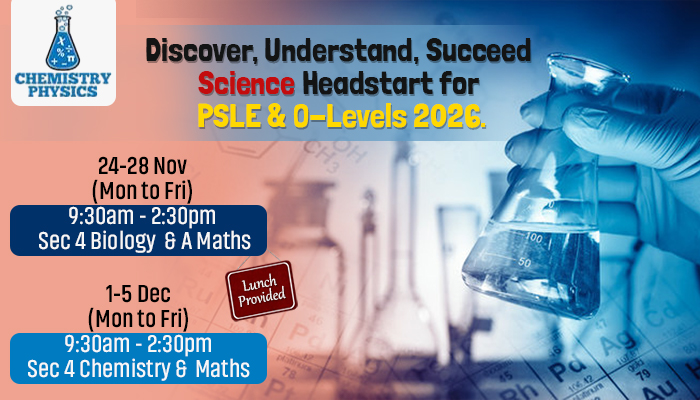
Our Nov/ Dec crash course in Singapore revisits these topics slowly, ensures students understand the logic, and provides the space to practise until it becomes natural.
2. Strengthen Through Practical Learning
Science is not just about reading. Without practical work, students often fail to see how concepts apply. In many schools, practicals are rushed or skipped, especially towards the end of the year.
At Miracle Learning Centre, we bring back that missing piece with hands-on experiments.
- In Chemistry tuition, students revisit Qualitative Analysis and Mole-based reactions. Instead of only memorising tests, they practise with real reagents and step-by-step guidance.
- In Biology tuition, pupils work through osmosis, enzyme activity and experimental design. They use diagrams alongside experiments, so the concept is understood both visually and practically.
Our chemistry and biology crash courses ensure that theory and practice go together. Students who once feared the lab begin to feel comfortable because they have touched, tested and applied the concepts.
3. Train Specifically for Open-Ended Questions
Parents often tell us, “My child knew the answer, but lost marks because they did not phrase it correctly.” This is a common problem in both PSLE and O-Level Science.
- Primary Science preparations must focus on helping pupils write answers for PSLE that include the exact keywords from the MOE marking scheme.
- Cell biology crash course sessions at the Secondary level teach students to explain processes like osmosis or enzyme activity with the right scientific language.
4. Break Down the Mole Concept Step by Step
If there is one area that regularly troubles students in Chemistry tuition, it is the Mole Concept. Introduced late and often rushed, it leaves many students confused.
We see difficulties in:
- Stoichiometry
- Limiting reagents
- Mass and volume calculations
- Applying balanced equations
Our chem crash course simplifies this with visual aids, real-world examples and repeated exam-style practice. By the end of the chemistry crash course, students no longer fear mole questions because they know the exact steps to follow.
5. Rebuild Biology from the Cell Up
In Biology, confidence begins with understanding cells. Without this, later topics such as nutrition, respiration and homeostasis remain unclear. We often meet students who confuse diffusion with active transport or cannot explain why enzymes denature.
Our cell biology crash course starts by clarifying the basics with diagrams, lab work and guided practice. From there, we extend into respiration, excretion and data-based questions. For many, this is the point where Biology shifts from memorisation to true understanding.
This foundation also strengthens advanced areas taught in Sec 4, making the rest of the exam syllabus much more manageable.
6. Use the Holiday Period as a Reset
During term time, students juggle school, homework, CCA and tests. They have little time for deep revision. By contrast, the holidays offer focus. A crash course in Singapore allows them to spend consecutive days on one subject, reinforcing difficult topics until they stick.
Parents in Bukit Timah and other competitive areas often look for the best science tuition centre because they know the value of this concentrated practice. Our biochem crash course, biology crash course and chemistry crash course are designed exactly for this reset.
- Students revisit their weakest areas daily instead of weekly.
- They practise exam-style questions under guidance.
- They begin the new year with confidence instead of doubt.
One Step Parents Can Take Now
At Miracle Learning Centre, we know the MOE syllabus deeply. We know which topics get rushed and which concepts students only pretend to understand. More importantly, we know how to fix them.
If your child is heading into Primary 6 or Sec 4 in 2026, this holiday is the chance to reset. Contact us today or click to enrol for primary or secondary crash courses and give your child the boost they need for PSLE and O-Level success.



2 comments
Pingback: A Level Physics & Chemistry Study Strategies | MLC
Pingback: How Chemistry Tuition Shapes Your Future
Comments are closed.