
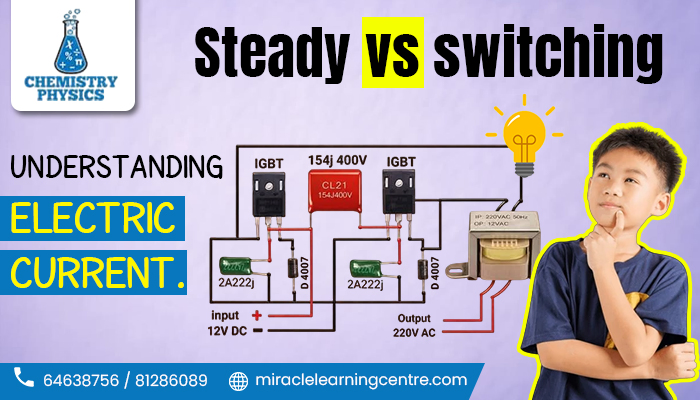
Electricity is not only about formulas. It is about understanding how and why current flows, how devices work, and how power is safely delivered to homes and industries. Let’s explore AC and DC circuits in a clear, conceptual, and practical way.
PART 1: D.C Circuit (Direct Current Circuit)
What is Direct Current?
Direct Current (DC) is electricity that flows in one direction only. Imagine water flowing in a pipe continuously in one direction, that is how DC behaves.
Everyday Examples:
- Torchlight battery
- Remote control batteries
- Power banks
- Solar panels
How DC Actually Works (Conceptually)
Inside a battery:
- Chemical energy creates an electric force.
- Electrons move from negative terminal to positive terminal.
- The flow continues as long as the circuit is closed.
If you open the switch ? flow stops.
Real Understanding of Key DC Concepts
Current (I)
- Flow of electric charge.
- Think of it as the speed of flowing water.
Voltage (V)
- Electrical pressure that pushes charges.
- Think of it as water pressure.
Resistance (R)
- Opposition to current flow.
- Think of it as a narrow pipe restricting water.
Series vs Parallel – Conceptual Understanding
Series Circuit
- One path only
- If one bulb fails ? all stop
- Current same everywhere
- Used in older decorative lights
Why? Because there is only one road for electrons.
Parallel Circuit
- Multiple paths
- If one bulb fails – others still work
- Same voltage across branches
- Used in house wiring
Why? Because electrons have multiple roads.
Why DC is Important
- Safe for electronics
- Used in mobile phones
- Essential for computer circuits
- Used in electric vehicles
- Stored easily in batteries
Common Mistakes Students Make (DC)
Thinking current gets “used up”
It doesn’t. Energy is used, not current.
Confusing voltage and curren
Voltage pushes, current flows.
Forgetting to check if circuit is closed
Advanced Concept (JC Level)
Internal Resistance
- Real batteries are not perfect.
- Some energy is lost inside the battery as heat.
Charging and Discharging
Capacitors store electrical energy and release it gradually.
This concept is used in:
- Camera flash
- Power backup circuits
PART 2: A.C Circuit (Alternating Current Circuit)
What is Alternating Current?
Alternating Current (AC) changes direction again and again.
Instead of flowing one way like DC,
it moves forward -> then backward -> repeatedly.
In most countries:
It changes direction 50 times per second (50 Hz)
Why Does AC Change Direction?
AC is generated by rotating turbines in power stations.
As the generator spins:
- Magnetic field changes
- Current direction reverses naturally
This makes AC easier to generate in large amounts.
Concept of the Sine Wave
AC voltage rises gradually -> reaches maximum -> falls -> becomes negative -> repeats.
It is smooth and continuous.
This smooth variation makes AC efficient for power transmission.
Why AC is Used in Homes
- Can travel long distances with less energy loss
- Can easily increase or decrease voltage using transformers
- Cheaper for national power supply
Key AC Concepts (Understanding, Not Memorizing)
Frequency
How fast direction changes.
Higher frequency -> faster oscillation.
RMS Value
AC voltage is always changing.
RMS value tells us the “effective” usable voltage.
Example:
When we say 230V at home,
that is RMS value — not peak.
Phase Difference
In AC circuits:
Current and voltage are not always synchronized.
- In resistor -> perfectly aligned
- In inductor -> current lags
- In capacitor -> current leads
This happens because:
- Inductor stores energy in magnetic field
- Capacitor stores energy in electric field
They delay current flow differently.
Real Life Examples of AC Components
- Ceiling fan motor -> uses inductance
- Charger circuits -> use capacitors
- Radio tuning -> uses resonance
- Transformers -> work only with AC
Resonance (Very Important for JC)
When inductive effect equals capacitive effect:
- The circuit becomes very efficient.
- Current becomes maximum.
Used in:
- Radio frequency tuning
- Communication systems
Deep Comparison: AC vs DC
| Concept | DC | AC |
|---|---|---|
| Flow | One direction | Reverses direction |
| Energy storage | Easy | Difficult |
| Long distance transmission | Not efficient | Very efficient |
| Used in | Electronics | Power grids |
| Complexity | Simple | More advanced |
Practical Understanding
Why Do Chargers Convert AC to DC?
Because:
- Electronics need stable voltage.
- AC keeps changing.
- A rectifier converts AC -> DC.
Why High Voltage is Used for Transmission?
- Higher voltage -> Lower current
- Lower current -> Less heat loss
- Less heat loss -> More efficiency
This is a basic physics principle.
What Each Student Level Must Truly Understand
Primary Students:
- Battery and bulb connection
- Closed circuit
- Series and parallel basics
Secondary Students:
- Concept of current, voltage
- Energy conversion
- AC waveform
- Household electricity safety
Junior College Students:
- Phasor diagrams
- Impedance concept
- Resonance
- Power factor
- Energy losses in transmission
Safety Rules Every Student Should Know
- Never touch live wires
- ry hands before using switches
- Avoid overloading sockets
- Understand difference between AC mains and DC battery
Why Deep Understanding Matters
AC and DC circuits are the foundation of:
- Engineering
- Robotics
- Renewable energy
- Electronics
- Computer hardware
If you truly understand concepts (not just formulas), you can solve any circuit problem confidently.
Want Structured Learning & Expert Guidance?
To master:
- Concept clarity
- Exam techniques
- Problem-solving skills
- Step-by-step learning for Primary to JC levels
Miracle Learning Centre helps students build strong foundations, not just memorise formulas but understand the WHY behind every concept.
To truly master AC and DC topics, students need more than memorisation; they need guided practice, conceptual discussions, and targeted problem-solving. This is why structured physics tuition Singapore programmes focus on breaking complex ideas like internal resistance, phasors, and resonance into understandable steps. Through small group physics tuition, learners can ask questions freely, correct misconceptions early, and steadily build confidence when tackling challenging circuit questions.
For advanced learners, especially those preparing for national examinations, specialised JC physics tuition Singapore and H2 physics tuition Singapore help bridge the gap between theory and application. Students learn how to interpret circuit behaviour, analyse waveforms, and approach exam questions strategically, turning difficult AC and DC problems into manageable and logical solutions.