
The Laws of Thermodynamics is not just a chapter in your physics book. They are applicable in all our regular activities, even the ones that we don’t even pay attention to.
For example, your mobile phone heats up after consistent usage. Then a glass of hot milk eventually cools down, even if you do nothing to it.
Do you think that these common experiences are random? Well, they aren’t the laws of thermodynamics apply to each of them.
If you are studying Physics in secondary school or JC, you already know this topic is not just about memorising statements. Examiners want to see whether you truly understand how energy moves, changes form, and interacts within a thermodynamic system.
Although the formulas feel abstract right now, if you can visualise what’s happening, they will be easier to understand and manage later.
And that’s exactly what our physics tuition classes aim to achieve. But firstly, let’s learn about the laws that make this chapter both easy and exciting.
First Law: Energy Cannot Be Created Or Destroyed But Only Transformed
The first law of thermodynamics teaches us that energy can only change from one form to another. It can neither be created nor destroyed.
And that idea changes everything we have known or assumed so far.
For example, if the energy enters a system in the form of heat, it must be used to do some work. A few concepts that you should know are:
- Energy Balance – Whatever goes in must show up somewhere, as it can’t disappear.
- Internal Energy – This refers to the microscopic energy stored within particles.
- Work Done – Energy can leave the system when it pushes against its surroundings.
In exams, students often forget to define the thermodynamic system clearly. Is it the gas inside the piston? The entire container? Your answer depends on this definition. During our Physics Tuition sessions, we guide students step by step so they can identify the system correctly before applying formulas.
Second Law: Understanding The Direction Of The Natural Flow Of Energy
Why does energy only flow from hot objects to cold ones naturally?
Without external work, it never flows the other way. Why is it so?
The temperature of any object reflects how fast particles move inside it on average.
- In a hot object, particles move faster.
- In a cold one, they move slower.
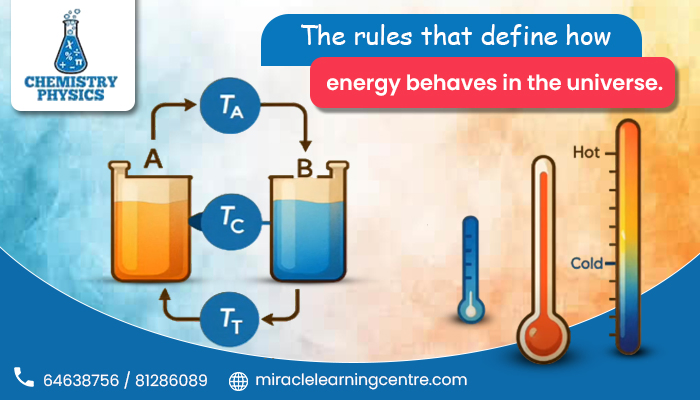
When the two are placed in contact, the faster particles collide with slower ones and transfer the energy. Over time, their speeds become more similar until both objects reach the same temperature. This direction happens naturally because energy spreading out is far more probable than energy concentrating in one place.
A few concepts to master:
- Heat Transfer – Thermal energy moves from higher temperature to lower temperature.
- Entropy Concept – Systems tend toward greater disorder over time.
- Efficiency Limits – No heat engine can be one hundred percent efficient.
Third Law – Absolute Zero Temperatures And What Happens
The third law of Thermodynamics tells us something important about what happens at extremely low temperatures. It says that as temperature gets closer and closer to absolute zero, the disorder in a perfect crystal becomes closer to zero.
Still confused? Let’s explain properly.
So at higher temperatures, we already know that particles vibrate and move around more. That movement creates disorder. As temperature decreases, these particles lose energy and vibrate with a lesser frequency.
At absolute zero, which is 0 Kelvin or minus 273.15 degrees Celsius, particles would have the minimum possible motion allowed by nature. In a perfect crystal, every particle would be arranged in a completely orderly structure. That means entropy, which measures disorder, would be at its minimum value.
Now here is the important part.
Absolute zero cannot actually be reached. We can get very close in laboratories using advanced cooling techniques, but we can never remove all thermal energy completely. There will always be a tiny amount of motion left.
For students, this law comes with some key ideas:
- Absolute Zero – It is the lowest possible temperature, not just very cold, but the theoretical limit of cooling.
- Particle Motion – Lower temperature means lower average kinetic energy of particles.
- Practical Limits – No real system can reach perfect zero motion.
In exams, this law often connects to entropy, temperature scales, and molecular behaviour. Once you link temperature with particle motion clearly in your mind, this concept becomes much easier to remember and apply.
Ideal Gas Law and Thermodynamics
When you study thermodynamics in JC Physics, the Ideal Gas Law shows up again and again. It is the link between pressure, volume, temperature, and the amount of gas inside a thermodynamic system.
The equation PV = nRT connects these four quantities clearly.
Pressure times volume equals the number of moles multiplied by the gas constant and temperature. If one variable changes, at least one other must respond. That relationship is what most exam questions are built around.
In many H2 questions, the Ideal Gas Law is combined with the first law of thermodynamics. You might first calculate a temperature change using PV = nRT, then use that result to find work done or change in internal energy. If you rush and treat the equation as a plug in formula, it becomes confusing. If you understand what is happening physically, it becomes manageable.
You also need to recognise different process types.
- Isothermal means constant temperature.
- Isobaric means constant pressure.
- Adiabatic means no heat transfer.
Each affects the thermodynamic system differently
In Case You Still Feel Stuck With Thermodynamics
The Laws of Thermodynamics is one of those chapters where once it clicks, it really clicks.
At Miracle Learning Centre, our focus is on ‘making it click’, so students gain a genuine interest not only in the topic but related ones as well. In our Science and JC Physics Tuition classes, we walk you through real exam style questions, correct your thinking process, and make sure you understand why each step works and how. After a few structured lessons, you’ll start feeling more confident and even loving the chapter.
If you want that shift, opt for our guidance immediately. Our experienced physics tutors are always ready to help with chapters that feel heavy at first but get better with conceptual knowledge.