In today’s fast-changing world, Polymers play a crucial role in almost everything we use daily. From packaging materials to high-tech medical devices, polymers have transformed how we live, study, and innovate. For students attending Chemistry Tuition or Science Tuition, understanding polymers is not only important for exams but also for developing real-world awareness.
At a leading Tuition Centre in Singapore, students are encouraged to connect textbook concepts with real-life applications. This makes topics like polymers more interesting, practical, and easier to remember.
What Are Polymers?
Polymers are macromolecules formed by joining many small repeating units called monomers through chemical reactions known as polymerisation.
To understand this better, imagine a train:
- Each monomer is like a single carriage
- The polymer is the entire train
The length and structure of this “train” determine the properties of the material.
Types of Polymerisation:
- Addition Polymerisation
- Monomers add together without losing atoms
- Example: Polyethene
- Condensation Polymerisation
- Monomers join with the loss of small molecules (like water)
- Example: Nylon, polyester
Extra Insight for Students:
In JC Chemistry, students explore reaction mechanisms, while Secondary students focus on identifying polymer types and properties.
From Plastic Bottles to Polymers
Plastic bottles are one of the most common examples of synthetic polymers. They are mainly made from Polyethylene Terephthalate (PET).
Why PET is Important:
- It is strong yet lightweight
- It resists water and chemicals
- It can be moulded into different shapes
Deeper Understanding:
PET is formed through condensation polymerisation between:
- Ethylene glycol
- Terephthalic acid
This creates long chains that give PET its strength and flexibility.
Everyday Connection:
Every time you buy a bottled drink, you are using advanced polymer chemistry developed through decades of research.
In Science Tuition, teachers often use such examples to help students visualise abstract concepts.
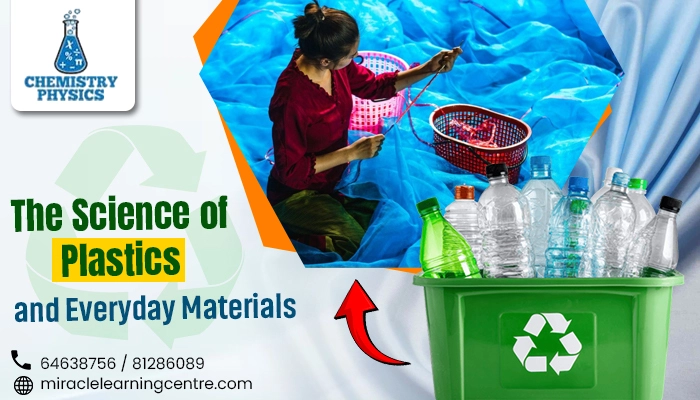
Turning Plastic Bottles into Synthetic Fibers
One of the most exciting developments in polymer science is converting waste plastic into useful materials like synthetic fibers.
Detailed Process:
- Collection of used plastic bottles
- Sorting and cleaning
- Crushing into flakes
- Heating and melting
- Extruding into fine threads
- Spinning into yarn
Why This Matters:
This process helps reduce landfill waste and supports the circular economy.
Real-Life Applications:
- Sportswear made from recycled plastic
- Eco-friendly school uniforms
- Durable backpacks
Advanced Insight:
Polyester fibers are valued for:
- High tensile strength
- Resistance to shrinking
- Quick drying properties
This is why they are widely used in modern textiles.
Environmental Impact of Polymers in 2026
As we move into 2026, the environmental impact of polymers has become a major global concern.
Expanded Issues:
1. Overproduction of Plastics
Global plastic production continues to rise due to demand in packaging, healthcare, and electronics. This creates a massive waste management challenge.
2. Microplastics in Daily Life
Microplastics are now found in:
- Drinking water
- Food
- Even human blood (recent studies)
This has raised serious health concerns.
3. Synthetic Fiber Pollution
When clothes made of polyester are washed:
- Tiny fibers are released
- These enter rivers and oceans
- Marine life consumes them
4. Climate Impact
Plastic production relies heavily on fossil fuels, contributing to:
- Carbon emissions
- Global warming
5. Waste Management Challenges in Cities
Urban areas (including developed cities like Singapore) face pressure to:
- Improve recycling systems
- Reduce waste generation
Latest Research on Solving Polymer & Plastic Pollution
1. Biodegradable Polymers
What research says:
- Scientists are developing biodegradable polymers like PLA, PHA, and chitosan
- These materials can break down into CO₂, water, and biomass with microorganisms
Key findings (2026):
- Can reduce plastic waste by up to 27% by 2050
- Can lower microplastic toxicity by ~34%
Important note:
They need specific conditions (heat, microbes) to fully degrade
2. Advanced Microplastic Removal Technologies
New technologies include:
- Membrane bioreactors (filters tiny plastic particles)
- Electrocoagulation (uses electricity to remove pollutants)
- AI-based detection systems
Research highlights:
- These technologies can detect microplastics as small as 100 nanometers
- Improved wastewater treatment reduces pollution entering oceans
Why this matters:
Microplastics are now found in drinking water and food, making this research very important.
3. Circular Economy
New approach:
Instead of throwing plastics away, scientists promote a circular economy:
Recycle → Reuse → Remanufacture
Research insight:
Combining recycling + biodegradable plastics can reduce waste by up to 65%
Real-world example:
Plastic bottles → Polyester fibers (clothing)
4. Microbial & Enzyme-Based Plastic Degradation
What scientists discovered:
- Certain bacteria and enzymes can “eat” plastic
- Example: PETase enzyme breaks down PET bottles
Research direction:
- Focus on faster and more efficient degradation
- Using biotechnology to scale solutions
5. Smart Polymers & AI-Designed Materials
Latest innovation:
- Smart polymers that respond to environment (heat, light)
- AI-designed materials for better recyclability
Research trend:
- AI helps design polymers with:
- Faster degradation
- Lower environmental impact
This is where Chemistry meets technology and AI.
6. Global Policies & Regulations (2025–2026)
What’s happening worldwide:
- Countries are working on global plastic treaties
- Stricter rules on microplastics and single-use plastics
Examples:
- Bans on microbeads in cosmetics
- Regulations on plastic waste disposal
- Incentives for biodegradable materials
Policies are essential because science alone cannot solve the problem.
Key Challenge Highlighted by Research
Even the best solutions have limitations:
- Biodegradable plastics may still create temporary microplastics
- Some produce greenhouse gases during breakdown
- Recycling systems are still not efficient worldwide
This shows why students must understand both advantages and disadvantages.
Why This Topic is Important for Exams
Polymers are frequently tested in exams across all levels.
Common Question Types:
- Define polymers and monomers
- Explain polymerisation processes
- Compare addition vs condensation polymerisation
- Discuss environmental impacts
Student Tip:
Many students lose marks because they:
- Memorise without understanding
- Cannot apply concepts to real-life examples
This is where structured Science Tuition makes a big difference.
How Our Tuition Centre Helps You Master Polymers
At Miracle Learning Centre, we go beyond memorisation.
Our Teaching Approach:
- Concept-based learning
- Real-world examples (plastic → fiber → environment)
- Visual explanations and diagrams
- Exam-focused practice
Suitable for:
- Primary students building foundations
- Secondary students preparing for O-Levels
- JC students tackling advanced Chemistry
Our Chemistry Tuition ensures students fully understand complex topics like polymers with confidence.
Final Thoughts
Polymers are one of the most important topics in modern science. They connect chemistry with real-world challenges like sustainability and environmental protection.
From:
- Plastic bottles → To:
- Synthetic fibers → To:
- Global environmental issues
This topic helps students see the bigger picture of how science impacts everyday life.
Join a Trusted Tuition Centre in Singapore
If you want your child to:
- Understand concepts clearly
- Score better in exams
- Develop interest in science
Join our expert-led Chemistry Tuition at Miracle Learning Centre, Bukit Timah.