
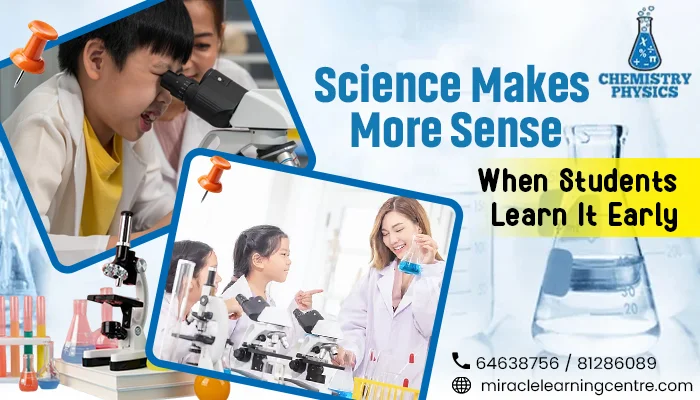
Primary Science becomes more demanding as students move into Primary 5 and Primary 6. They are no longer expected simply to remember facts. They must connect different concepts, interpret experiments and explain their answers using accurate scientific language.
A student may know that the heart pumps blood but struggle to explain how the circulatory and respiratory systems work together. Another may understand evaporation yet find it difficult to apply the concept to a water-cycle experiment.
Early preparation can make these topics feel less unfamiliar when they appear in school.
Miracle Learning Centre’s Primary Science crash course Singapore programmes give students entering Primary 5 and Primary 6 in 2027 an opportunity to study important topics during the 2026 November–December holidays.
Primary Science Head-Start Course Details
Two programmes are available for students entering their respective 2027 levels.
Headstart Primary 5 Science
For: Students entering Primary 5 in 2027
Dates: 23–26 November 2026
Days: Monday to Thursday
Time: 10:00 am–2:00 pm
Course fee: $550
Lunch: Provided
Topics include:
- Circulatory System
- Respiratory System
- Diversity
- Water and Changes of State
- Cycles in Water
- Light
- Effects of Heat
Headstart Primary 6 Science (PSLE)
For: Students entering Primary 6 in 2027
Dates: 30 November–3 December 2026
Days: Monday to Thursday
Time: 10:00 am–2:00 pm
Course fee: $550
Lunch: Provided
Topics include:
- Effects of Heat
- Energy
- Forces
- Electricity
- Reproduction in Plants and Animals
- Life Cycles of Plants and Animals
- Human Systems
Both programmes include notes and worksheets, experiments and guidance with Science open-ended answering techniques. Classes will commence with at least five students.
Why Does Learning Primary Science Early Help?
A Primary Science head-start course is not intended to rush students through an entire year’s syllabus. Its purpose is to build familiarity with selected concepts before school lessons and assessments begin.
Early exposure can help students:
- Recognise important scientific terms
- Connect related topics more easily
- Identify gaps in prior knowledge
- Become familiar with application questions
- Practise writing complete scientific explanations
- Develop a more organised approach to experiments
- Begin the new academic year with a clearer foundation
Science concepts are often connected across several levels. For example, understanding heat helps students explain changes of state and parts of the water cycle. Understanding plant and animal life cycles supports later learning about reproduction.
When these connections are clear, Science becomes more meaningful and less dependent on memorisation.
What Students Learn in the Primary 5 Science Crash Course
The Primary 5 Science crash course introduces topics from life science and physical science. Students learn about processes within the human body as well as observable changes in their surroundings.
The Circulatory System
The circulatory system transports substances around the human body.
Students learn about:
- The heart
- Blood
- Blood vessels
- The transportation of oxygen
- The transportation of digested food
- The removal of waste products
It is not enough to state that the heart pumps blood. Students must understand why circulation is necessary and how transported substances support the body’s cells.
Questions may also require students to interpret pulse-rate data or explain why the heart beats faster during physical activity.
The Respiratory System
The respiratory system allows gas exchange to take place.
Students study structures such as:
- Nose
- Windpipe
- Lungs
- Air tubes
- Diaphragm
This topic is closely connected to the circulatory system. Oxygen enters the body through the respiratory system and is transported by the blood. Carbon dioxide is carried back to the lungs and removed during exhalation.
Recognising this connection helps students answer questions about how human systems work together.
Diversity
Diversity involves observing, comparing and classifying living and non-living things.
Students may need to group organisms according to their characteristics. A strong answer must use observable scientific features rather than assumptions.
For example, students could compare animals according to:
- Body covering
- Method of reproduction
- Habitat
- Movement
- Presence of a backbone
Diversity develops observation and classification skills that students use throughout Primary Science.
Water and Changes of State
Water can exist as a solid, liquid or gas. Students must understand the processes responsible for changes between these states.
Important processes include:
- Melting
- Freezing
- Evaporation
- Boiling
- Condensation
Students frequently confuse evaporation with boiling. Evaporation can occur at different temperatures from the surface of a liquid, while boiling occurs throughout a liquid at its boiling point under a given pressure.
Application questions may ask students to explain why wet clothes dry, droplets appear on a cold surface or water levels decrease over time.
Cycles in Water
The water cycle connects evaporation, condensation and precipitation.
Heat from the Sun causes water to evaporate. Water vapour rises, cools and condenses to form tiny droplets in clouds. Water eventually returns to Earth through precipitation.
Students need to understand that water is continuously recycled. They should also distinguish the processes involved instead of memorising a diagram without understanding it.
Light
The Light topic introduces important ideas about how we see objects and how shadows form.
Students learn that:
- Light travels from a source
- We see an object when light enters our eyes
- Transparent materials allow most light to pass through
- Translucent materials allow some light to pass through
- Opaque materials block light
- Shadows form when an opaque object blocks light
Questions may require students to predict how moving a light source or object changes the size and position of a shadow.
Effects of Heat
Heat can change the temperature, size or state of matter.
Students may study:
- Heating and cooling
- Expansion and contraction
- Melting and freezing
- Evaporation and condensation
- Conductors and insulators
This topic requires students to identify heat transfer and explain resulting changes using appropriate scientific concepts.
What Students Learn in the Primary 6 Science Crash Course
The Primary 6 Science crash course is designed for students entering their PSLE year. It covers several major topics while supporting early PSLE Science preparation.
Effects of Heat
Primary 6 students revisit heat concepts through more complex applications.
They may need to:
- Compare materials
- Interpret experimental results
- Identify variables
- Explain fair-test conditions
- Connect heat transfer with changes in temperature or state
Revisiting this topic allows students to strengthen earlier concepts before attempting more demanding questions.
Energy
Energy allows changes and processes to occur. Students may encounter different forms of energy, including:
- Light energy
- Heat energy
- Electrical energy
- Sound energy
- Kinetic energy
- Potential energy
They must be able to identify energy conversions.
For example, an electric fan converts electrical energy into kinetic energy and sound energy. A torch converts chemical energy stored in a battery into electrical energy, followed by light and heat energy.
Forces
A force is a push or pull that can affect an object’s movement, direction or shape.
Students study forces such as:
- Gravitational force
- Friction
- Magnetic force
- Elastic spring force
Questions may require students to determine the forces acting on an object or explain how changing a surface affects friction.
Drawing a clear force diagram and identifying the direction of each force can make these questions easier to analyse.
Electricity
Electricity questions require both conceptual understanding and careful diagram interpretation.
Students may work with:
- Electrical circuits
- Conductors and insulators
- Cells
- Bulbs
- Switches
- Series and parallel arrangements
They must understand that a bulb lights only when it is part of a complete circuit. They may also need to compare bulb brightness when circuit arrangements change.
Reproduction in Plants and Animals
Reproduction allows living organisms to produce offspring and continue their species.
Students learn about:
- Pollination
- Fertilisation in flowering plants
- Seed and fruit formation
- Seed dispersal
- Reproduction in animals
- Similarities between parents and offspring
Science questions may present unfamiliar plants or animals. Students must apply general reproductive principles to the information provided.
Life Cycles of Plants and Animals
A life cycle shows the stages through which a living organism passes.
Students may compare the life cycles of:
- Flowering plants
- Butterflies
- Beetles
- Mosquitoes
- Frogs
- Other animals
Instead of remembering diagrams alone, students should understand how organisms grow, develop and reproduce.
Human Systems
Human Systems brings together concepts such as:
- Digestive System
- Respiratory System
- Circulatory System
- Transport of substances
- Relationships between body systems
Students may be asked to explain how several systems work together. For example, the digestive system provides digested nutrients, the respiratory system supplies oxygen and the circulatory system transports these substances to cells.
This topic tests whether students can form connections rather than recall isolated facts.
Why PSLE Science Open-Ended Questions Can Be Difficult
Many students understand a topic but lose marks because their written answers are incomplete or imprecise.
PSLE Science open-ended questions may require students to:
- Identify the correct concept
- Refer to information from a diagram or experiment
- Explain a cause-and-effect relationship
- Compare two situations
- State observations rather than conclusions
- Use accurate scientific vocabulary
- Link several points in a logical order
For example, writing “the plant gets more light” may not fully answer a question. A stronger explanation may need to connect greater light intensity to a faster rate of photosynthesis and increased food production, depending on the evidence and wording of the question.
Good answering technique begins with understanding what the question is asking. Students should look closely at command words such as “state”, “describe”, “compare”, “explain” and “predict”.
How Experiments Support Science Understanding
Experiments help students see how scientific concepts apply in observable situations.
Students can practise identifying:
- The aim of an experiment
- The changed variable
- The measured variable
- The variables kept constant
- The observation
- The conclusion
- Possible sources of error
An experiment question is not only about remembering content. It tests whether students can reason from evidence.
A focused Science holiday programme Singapore gives students time to discuss experimental setups and understand why specific conditions must be controlled.
Primary 5 or Primary 6: Which Programme Is Suitable?
The programmes are organised according to the level students will enter in 2027.
Choose the Primary 5 Science crash course if your child will enter Primary 5 in 2027 and needs early exposure to Upper Primary Science topics.
Choose the Primary 6 Science crash course if your child will enter Primary 6 in 2027 and is beginning focused preparation for the PSLE year.
Parents unsure about the appropriate programme should speak with the centre before registration.
Frequently Asked Questions
When is the Primary 5 Science programme?
It runs from 23 to 26 November 2026, Monday to Thursday, from 10:00 am to 2:00 pm.
When is the Primary 6 Science programme?
It runs from 30 November to 3 December 2026, Monday to Thursday, from 10:00 am to 2:00 pm.
How much does each programme cost?
Each four-day programme costs $550. Lunch is provided.
Are notes and worksheets included?
Yes. Notes and worksheets are provided for both programmes.
Will students practise open-ended questions?
Yes. The programmes include guidance on Primary and PSLE Science open-ended answering techniques.
Are experiments included?
Yes. Experiments form part of the Primary Science crash-course programme.
Is there a minimum class size?
Yes. Each Primary course will commence with at least five students.
Is this regular weekly tuition?
No. These are concentrated holiday head-start programmes. Parents seeking continuing Primary Science tuition Singapore can contact the centre to discuss suitable regular classes.
Help Your Child Build an Earlier Science Foundation
Science becomes easier to understand when students can connect facts, processes, diagrams and experimental evidence.
Miracle Learning Centre’s Primary Science crash course Singapore programmes provide a structured opportunity for students entering Primary 5 and Primary 6 in 2027 to begin selected topics before the new school year.
Families looking for Science tuition Bukit Timah can find Miracle Learning Centre at:
144 Upper Bukit Timah Road, #03-01 Beauty World Centre, Singapore 588177
For course availability and registration:
Call or WhatsApp: +65 8128 6089